Showing posts with label gravity. Show all posts

Friday, June 20, 2014

Very Tiny Gravitational Constant Measured

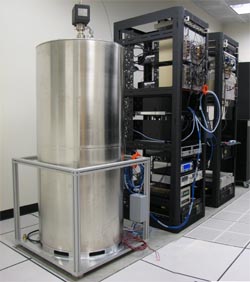
A rubidium fountain, though this is a clock, not an experiment.
Wait a minute, says everyone who's taken a physics class.  Don't we already know what the
gravitational constant is?  Isn't it part of Newton's equations? Yes, the gravitational constant has been measured many times, although not actually by Newton himself.  It was first calculated in 1798, and has been adjusted quite a bit over the years to considerable accuracy.  Or so we thought.  As it turns out, all those values for the gravitational constant in the equation
Fg = G * m1m2 / r2 were wrong.  The problem is that the gravitational force is so tiny that virtually anything could cause errors.  So the value of the gravitational constant is not nearly as well known as other constants such as the speed of light.


In an experiment involving a rubidium atomic fountain and several hundred kilograms of tungsten, scientists have found an error-free value for the gravitational constant.  The value they got is 6.67191 × 10⁻¹¹ m3 kg-1 s-2, while the previously accepted value was 6.67384 × 10⁻¹¹ m3 kg-1 s-2.  That doesn't sound like very much, I know I only used 6.67 in my physics classes, and I'm sure that's all anybody would use just using that equation casually.  But for physicists, that is a big difference.  This new value isn't as precise as old values, but it is more accurate, and it raises hopes that a both precise and accurate value for the gravitational constant will soon be agreed upon.

My Other Blogs
Loose on the Internet
Cool Golf News

My Twitter

Friday, May 30, 2014

How Other Objects in the Solar System Effect Earth's Habitability

Jupiter is by far the most influential planet gravitationally speaking in our solar system, which makes sense, because it is the biggest.  It is constantly redirecting asteroids and comets one way or another, and you could make the argument that this helps or hurts the Earth.  Overall, Jupiter's effects on Earth probably balance out to being neutral.  But what if Jupiter had formed somewhere else in the solar system?  Would Earth still be habitable if it was much closer, or much further away?  The answer is interesting, but not for the reasons that I thought.

One of the most interesting things in that article is how the Moon influences Earth.  I've watched completely reputable shows and heard quite a bit about how the Moon is so important to maintaining our climate, and without it, Earth probably wouldn't even be habitable.  The idea that a large moon is key to life is a big tenet of the Rare Earth Hypothesis.  But according to this article, a planet without a large moon should remain stable for much longer than the Earth is going to with its moon.  If the Moon suddenly disappeared today, it would wreak havoc on Earth, but if the Moon had never been there, the problem of sudden destabilization wouldn't be present.

This whole business got scientists thinking about how big planets could help or hurt the habitability of habitable planets in the inner solar system.  So, scientists began running simulations on Jupiter, the only planet that has a really noticeable gravitational effect on Earth.  They brought in closer, they brought further away, they gave it an eccentric orbit, but for the most part, Earth's orbit and axis remained about the same.  There are some interesting implications to this study, for instance, it shows that compact solar systems are less likely to host habitable worlds because gravity would imbalance a small world quicker.  It also gives credence to the idea that solar system formation is a chaotic one, and that the places planets end up is as much up to chance as it is to physics.

My Other Blogs
Loose on the Internet
Cool Golf News

My Twitter

Thursday, May 1, 2014

The Search for Dark Matter Soldiers On

It's funny how science works sometimes.  We know quite a bit about dark matter, we know it's out there, we know how much of it there is, we know what its effects are, but we don't know what it is. At the very least, we've narrowed things down a bit.  Theories used to range from subatomic particles to black holes to brown dwarfs, now, scientists are pretty sure it's some sort of subatomic particle.

Of course, that's about all we know right now.  Candidates for dark matter currently include WIMP's, or Weakly Interacting Massive Particles, sterile neutrinos, and axions.  WIMP's are about 100 times more massive than electrons, only interact through gravity and the weak nuclear force, and do not interact very well with normal matter.  They do interact with each other, destroying each other and emitting gamma rays while doing so.  At least, this is the theory, because scientists haven't actually discovered one yet.  Next we have sterile neutrinos, a type of neutrino that interacts with fewer things than regular neutrinos, which don't interact with much.  According to the theory, sterile neutrinos only interact with gravity.  Again, they're something we're pretty sure exist, but we don't really have any means of detecting them.  All we can do is measure the effects they have.  Finally, there are axions, which should exist according to nuclear physics in high numbers, but once again, we have yet to detect any.  There is a project devoted to finding them, which should have definitive results in a few years if axions exists.

In any event, dark matter is probably made up of a combination of these various particles, not just one of them.  I suppose this is all good news in the search for dark matter, but it would be nice if we were sure even one of the proposed particles actually existed.  All three are theoretical at this point, and that just makes it difficult for me to get particularly excited.  I'm guessing it'll be another ten years at least before scientists are confident enough on the composition of dark matter to say definitively what it is.

My Other Blogs
Loose on the Internet
Cool Golf News

My Twitter


Monday, March 31, 2014

Cosmos Episode 4 Thoughts

This Cosmos reboot just keeps getting better and better.  This last episode was all about gravity, light, and William Herschel.  Herschel, like Halley from last week, made incredible contributions to science, only to have most of them ignored.  Yes, discovering Uranus was very important, but his work with binary star systems was inspired.  Herschel was not the first to observe binaries, and as last night's episode revealed, his contemporary John Michell theorized their mechanics first, but Herschel's work would prove the most fruitful.  I really enjoyed the animated segments with Herschel and his son, it was interesting.

Last night's episode also recreated a segment from Carl Sagan's Cosmos, and one of Einstein's classic thought experiments on the nature of light.  Time dilation and the nature of light while moving at relativistic speeds is always fascinating to hear about, and while it may not be possible to really understand it, I think Tyson made it easy for people to at least wrap their mind around the idea.

The best part of the episode was the black holes.  From the animation of Herschel talking about dark stars to the black hole dive with callbacks to 2001: A Space Odyssey, it was an intense and enlightening segment.  Sure, it was all theory crafting because we have no idea what happens within a black hole, but this is the ship of the imagination.  And if we do ever figure black holes out, the truth will always be stranger than what we can possibly imagine.  From the black hole, we went straight to the most poignant part, where Tyson talked about John Herschel, and how photography is a sort of time travel.  A great episode, from start to finish.

My Other Blogs
Loose on the Internet
Cool Golf News

My Twitter