We've discovered over a thousand extrasolar planets, with thousands more waiting to be confirmed. The problem is that we don't know anything about these planets. Sure, we know their size, their approximate mass, and how close they orbit their star, but that can only tell us so much. We need a more powerful and more dedicated space-based telescope in order to perform a comprehensive search of an exoplanet, which is the only way we'll be able to tell if there's life on it, or even if it's capable of supporting life. Again, we've found plenty of planets in the habitable zone of their stars, but we can't tell anything about them. This sounds like a job for the James Webb Space Telescope, due to launch in 2018, and whose mission statement includes searching for exoplanets. Sounds great, right? We'll be finding life any time.
Turns out it probably won't be that easy. The JWST will be the biggest telescope ever put in space with a diameter of 6.5 meters. That's pretty big, but it's only big enough to survey in detail only the nearest exoplanets. We may get lucky and find something nearby, but odds are, we won't. To improve our odds, we need a telescope that's 10, maybe even 20 meters across, and the technology to get a telescope that big into space doesn't exist yet. It may take decades for us to launch a big enough telescope into orbit to find life out there in the galaxy, but every step we take is getting us closer to that ultimate goal.
My Other Blogs
Loose on the Internet
Cool Golf News
My Twitter
Showing posts with label astronomy. Show all posts
Tuesday, July 15, 2014
Sunday, July 6, 2014
Planetary Beer Series
Do you like astronomy and beer? Well, so do I. It's a market that is begging to be opened up, and now, it has been. Bell's Brewery, which is in one of the best named towns in the world (Kalamazoo), is starting a line of beers inspired by Gustov Holst's famous musical suite, "The Planets", which is of course based on...the planets. Each beer represents the character given to it in Holst's suite, for example, Mars is a strong double IPA to put one in the mood for war. We didn't know much about Neptune in the 19th century, it was a bit of a mystery, and so to represent this, Neptune's beer is a mystical stout, whatever that means. I want to try it just to find out. And a quick glance at the Wikipedia page says that you can get Bell's Brewery beers here in Pennsylvania. I'll have to keep a lookout for it.
My Other Blogs
Loose on the Internet
Cool Golf News
My Twitter
Labels:
astronomy,
beer,
bell's brewery,
gustav holst,
planets,
the planets
Tuesday, June 24, 2014
Diamond Star Found
You may have heard of the exoplanet 55 Cancri e. Not a catchy name, but you probably know it as the diamond planet. Now, it looks like there's a diamond star to go with it. We would have never found it were it not for its companion, PSR-J2222-0137, which is a pulsar. Pulsars are very precise things, and while observing this one, astronomers noticed significant warping was delaying the pulses. Because of the exact nature of the pulses, scientists were able to determine the exact mass of the objects. The pulsar was 1.2 solar masses, while the companion is 1.05 solar masses.
An object of that mass is probably a white dwarf, so we looked for one. But we couldn't find one. The resolution would have shown a star 10 times fainter than any previously known white dwarf, but there was nothing there. There is an object there, but we can't see it. It's been theorized that white dwarfs will slowly cool off into what is known as a black dwarf, but we've never seen one, because they're black (obviously) and they don't have the extreme gravitational pull a black hole does. We only found this one because it's in orbit around a pulsar. The star is still pretty hot at nearly 5,000 degrees Fahrenheit, but the carbon has crystallized, which is why we'll inevitably call this a diamond star.
My Other Blogs
Loose on the Internet
Cool Golf News
My Twitter
My Other Blogs
Loose on the Internet
Cool Golf News
My Twitter
Labels:
astronomy,
black dwarf,
diamond,
diamond planet,
diamond star,
pulsar,
white dwarf
Saturday, June 7, 2014
Supernovas in the Lab
Not literally, of course, but it's fairly close. It's also pretty cool. By firing a laser 60,000 billion times more powerful than your standard laser pointer at a thin carbon rod, scientists are able to approximate a supernova explosion. This is very cool, of course, but they are doing this for a good reason. Scientists expect supernovas to expand in all direction uniformly, but this is not always the case. Sometimes they have twists and knots, and we're not entirely sure why that happens. It was suspected that it was caused by patches of dust that interrupt the explosion, which in turn created magnetic fields that distort the star remains into unusual shapes, but we were never sure. By placing objects in with the carbon rod, we were able to simulate stellar clouds of gas and dust, and the smaller experimental version of supernova behaved in the same way as regular supernova. This is interesting news, but you know what? I want to make a supernova with big giant lasers, that is something that I want to do.
My Other Blogs
Loose on the Internet
Cool Golf News
My Twitter
My Other Blogs
Loose on the Internet
Cool Golf News
My Twitter
Labels:
astronomy,
carbon rod,
experiment,
lasers,
supernova
Monday, May 26, 2014
Alien Life Will Be Difficult to Find
![]() |
| It will be a long time before we find life like this. |
Even looking for life within our solar system is difficult. Take Europa. There's an ocean underneath the icy surface that very likely hosts some sort of life. However, there's no guarantee that life inhabits the entire ocean, and since scientists predict that Europa probably has even more water than Earth, we might not even find life on our first visit, which is looking like it will happen in about ten years. We've been looking for life on Mars for years now, and we haven't gotten anywhere with that either. We can't even say that life on Mars is unlikely, because we've explored so little of the planet, and life could be hiding in so many places. So, even though the technology is there, actually finding life may take a while. It's important to be patient with this sort of science.
My Other Blogs
Loose on the Internet
Cool Golf News
My Twitter
Wednesday, May 21, 2014
Confirmed: A Certain Kind of Big Star Explodes Like All the Other Big Stars
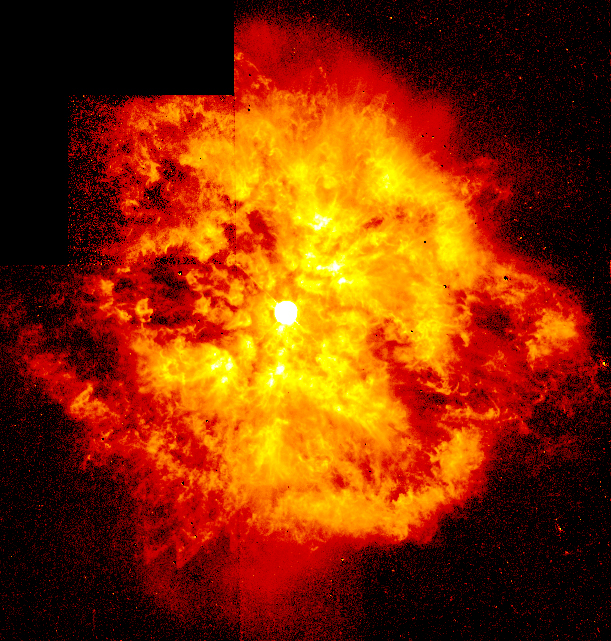
Astronomers were able to focus on supernova SN 2013cu mere hours after it was discovered, and this allowed the observation of ionized particles around the exploding star, a phenomenon that only lasts about a day. This is important because it allowed astronomers to accurately identify what the material surrounding the star actually was, and in this case, this material almost certainly came from a Wolf-Rayet star. This means that scientists can now say that Wolf-Rayet stars do go supernova like other stars of comparable size. This seems like a no-brainer, but we weren't entirely sure. Confirmation is important in science.
My Other Blogs
Loose on the Internet
Cool Golf News
My Twitter
Labels:
astronomy,
giant star,
sn 2013cu,
star,
star explosion,
supernova,
wolf-rayet
Thursday, April 24, 2014
Iapetus and the Incredibly Straight Mountain Range
Iapetus was made famous in the novel 2001: A Space Odyssey, being the home of the third monolith, and the gateway for David Bowman's incredible voyage to the stars. Arthur C. Clarke picked Iapetus over all the other moons of Saturn because of its curious coloration.
Half of the moon is a brilliant white, while the other is as black as coal. Scientists are still not entirely sure as to the reason for this, but Iapetus' dual color scheme is not the most unusual feature of the moon. The Cassini probe discovered a perfectly straight equatorial ridge running along a large portion of the moon, with some of the peaks reaching as high as 20 kilometers. Perfectly straight geologic features are not a common occurrence, and there have been many theories as to how the ridge formed.
In a recent paper, scientists believe that they have the most likely reason for the ridge's existence. The mountains are too steep to have been formed through traditional mountain building through plate tectonics, and Iapetus shows no signs of ever being volcanically active. The paper states that an impact between Iapetus and another object that kicked off a lot of debris is the most likely source of the ridge. The debris would have entered into orbit around Iapetus' equator and eventually fallen down, forming the ridge. So, there may have been a time when Iapetus had a ring system. Given that we recently discovered an asteroid with rings, a moon with rings doesn't seem so absurd.
My Other Blogs
Loose on the Internet
Cool Golf News
My Twitter
| Iapetus' Equatorial Ridge |
In a recent paper, scientists believe that they have the most likely reason for the ridge's existence. The mountains are too steep to have been formed through traditional mountain building through plate tectonics, and Iapetus shows no signs of ever being volcanically active. The paper states that an impact between Iapetus and another object that kicked off a lot of debris is the most likely source of the ridge. The debris would have entered into orbit around Iapetus' equator and eventually fallen down, forming the ridge. So, there may have been a time when Iapetus had a ring system. Given that we recently discovered an asteroid with rings, a moon with rings doesn't seem so absurd.
My Other Blogs
Loose on the Internet
Cool Golf News
My Twitter
Tuesday, April 15, 2014
April 15th Lunar Eclipse
I didn't get to see the eclipse last night. I was fully prepared to stay up until 3:45 AM to witness totality, but the weather decided not to cooperate. Rain wasn't having any of it. If this had been a solar eclipse, I would have been sorely disappointed. Solar eclipses are very rare, and only occur in very small bands. I believe the next solar eclipse in the United States is in 2017, and I have every intention of traveling to wherever totality will be occurring. A solar eclipse is something special, and is worth all the attention when they occur in populated areas.
Comparatively, lunar eclipses just aren't that special. I've already seen at least two in my life, and there's going to be three more lunar eclipses in the next two years. Sure, they're cool, but they're not really that impressive, or that rare. I don't really care for the term "blood moon" because it implies some sort of ominous presence to a relatively common event. The title of the article even has to assure the reader that this event isn't a sign of the apocalypse, which I might let slide on a general news site like CNN, but this is Space.com, a highly respected and important science news website. I guess there hasn't been a lunar eclipse in the United States in the social media era, which is why there's been such a big deal about it. I understand that the only way the general public is going to care about important scientific events like this is get them trending on social media, but I don't have to like it. People should care about science because it's important, not because it's what people are talking about right now on Twitter. That's the whole motivation behind the Cosmos reboot, science has taken a back seat in our society, and we need to bring it back to the forefront.
My Other Blogs
Loose on the Internet
Cool Golf News
My Twitter
(thank you irony)
Comparatively, lunar eclipses just aren't that special. I've already seen at least two in my life, and there's going to be three more lunar eclipses in the next two years. Sure, they're cool, but they're not really that impressive, or that rare. I don't really care for the term "blood moon" because it implies some sort of ominous presence to a relatively common event. The title of the article even has to assure the reader that this event isn't a sign of the apocalypse, which I might let slide on a general news site like CNN, but this is Space.com, a highly respected and important science news website. I guess there hasn't been a lunar eclipse in the United States in the social media era, which is why there's been such a big deal about it. I understand that the only way the general public is going to care about important scientific events like this is get them trending on social media, but I don't have to like it. People should care about science because it's important, not because it's what people are talking about right now on Twitter. That's the whole motivation behind the Cosmos reboot, science has taken a back seat in our society, and we need to bring it back to the forefront.
My Other Blogs
Loose on the Internet
Cool Golf News
My Twitter
(thank you irony)
Labels:
astronomy,
blood moon,
lunar eclipse,
science,
social media,
solar eclipse
Thursday, April 10, 2014
First Potential Exomoon
Scientists may have found an exomoon, the first one ever discovered. If it is a moon, then the system it resides in, MOA-2011-BLG-262, is an unusual one, because it would contain only a single Jupiter-sized planet and the moon. No star. Rogue planets, as such objects are called, are probably fairly common in the universe, but are extremely difficult to spot because they give off very little light.
You may have noticed that scientists aren't particularly sure if this is an exomoon or not. That's because of the way the discovery was made. The system was discovered using gravitational microlensing, which allows discovery of objects we would normally never be able to spot, but are events that only happen once. In this case, the event revealed that there are two objects in the system, and the orbiting object has 0.05% of the mass compared to the main object.
The issue here is that the scientists don't know how far away the system is. The microlensing event doesn't reveal that. If the system is far away, then the system is a dim star orbited by a smallish gas giant. If the system is closer, than it's a rogue Jupiter orbited by a roughly Earth-sized moon. The data we have indicates that it is a planet and moon, but a star and planet system is more likely to occur in nature. Unfortunately, we'll probably never know the real truth, because microlensing events only ever reveal these objects once. And since we don't know where the object is, we won't be able to look for it. Finding it again would constitute a complete accident.
My Other Blogs
Loose on the Internet
Cool Golf News
My Twitter
You may have noticed that scientists aren't particularly sure if this is an exomoon or not. That's because of the way the discovery was made. The system was discovered using gravitational microlensing, which allows discovery of objects we would normally never be able to spot, but are events that only happen once. In this case, the event revealed that there are two objects in the system, and the orbiting object has 0.05% of the mass compared to the main object.
The issue here is that the scientists don't know how far away the system is. The microlensing event doesn't reveal that. If the system is far away, then the system is a dim star orbited by a smallish gas giant. If the system is closer, than it's a rogue Jupiter orbited by a roughly Earth-sized moon. The data we have indicates that it is a planet and moon, but a star and planet system is more likely to occur in nature. Unfortunately, we'll probably never know the real truth, because microlensing events only ever reveal these objects once. And since we don't know where the object is, we won't be able to look for it. Finding it again would constitute a complete accident.
My Other Blogs
Loose on the Internet
Cool Golf News
My Twitter
Thursday, March 27, 2014
New Dwarf Planet
Scientists have discovered a dwarf planet which orbits in a strange place in the solar system. It's beyond the Kuiper Belt, but far within the Oort Cloud. The dwarf planet Sedna was previously discovered in the same area, but it was seen as a fluke, orbiting in a basically empty space. But with this, there might be good reason to think that there's a whole bunch of objects floating out there. It's an interesting development, and it just goes to show there is still so much to learn about our own solar system.
My Other Blogs
Loose on the Internet
Cool Golf News
My Twitter
My Other Blogs
Loose on the Internet
Cool Golf News
My Twitter
Wednesday, March 26, 2014
Ringed Asteroid
Scientists have recently discovered rings around an asteroid called Chariklo. This is certainly a big surprise, because only the large planets in our solar have ring systems, and it is certainly unprecedented for something as small as an asteroid to have it. I suppose this isn't exactly the most groundbreaking news ever, but it is really interesting, and completely unexpected.
My Other Blogs
Loose on the Internet
Cool Golf News
My Twitter
My Other Blogs
Loose on the Internet
Cool Golf News
My Twitter
Thursday, March 20, 2014
Introduction
Well, this is a blog that's about science. I know that's a real vague subject, but if I think it's interesting, I'll write about it. Now, my personal preference is for astronomy, so don't be surprised if that tends to be the most-written about subject here. But like I said, if it's interesting, and it's science, that you can find it here.
My Other Blogs
Loose on the Internet
Cool Golf News
My Twitter
My Other Blogs
Loose on the Internet
Cool Golf News
My Twitter
Subscribe to:
Posts (Atom)