Monday, May 26, 2014

Alien Life Will Be Difficult to Find

It will be a long time before we find life like this.
We are very near the point, technologically speaking, where mankind will be able to find life on another world, whether on a far-off exoplanet or within our own solar system.  However, actually finding it will be a formidable challenge.  The problem is simple, and best said in my favorite book, "Space is big.  You won't believe just how vastly, hugely, mind-bogglingly big it is.  I mean you may think it's a long way down the road to the chemist's, but that's just peanuts to space."

Even looking for life within our solar system is difficult.  Take Europa.  There's an ocean underneath the icy surface that very likely hosts some sort of life.  However, there's no guarantee that life inhabits the entire ocean, and since scientists predict that Europa probably has even more water than Earth, we might not even find life on our first visit, which is looking like it will happen in about ten years.  We've been looking for life on Mars for years now, and we haven't gotten anywhere with that either.  We can't even say that life on Mars is unlikely, because we've explored so little of the planet, and life could be hiding in so many places.  So, even though the technology is there, actually finding life may take a while.  It's important to be patient with this sort of science.

My Other Blogs
Loose on the Internet
Cool Golf News

My Twitter

Friday, May 23, 2014

Urine Isn't Sterile, After All

This is practical and ground-breaking news right here.  Turns out that you may want to wash your hands after you pee.  I know I usually don't, unless I'm in a public place where hand-touching may occur.  Turns out the test they used to reach the conclusion that urine was sterile may not have been as scientifically rigorous as you might have hoped.  This is a great reminder that nothing is permanent, even in science.  The most basic facts you think you know could turn out to be completely wrong.  Free inquiry is important, just in case the facts are wrong, somebody needs to able to get to the real truth.

My Other Blogs
Loose on the Internet
Cool Golf News

My Twitter

Thursday, May 22, 2014

Colorado River Reaches the Ocean

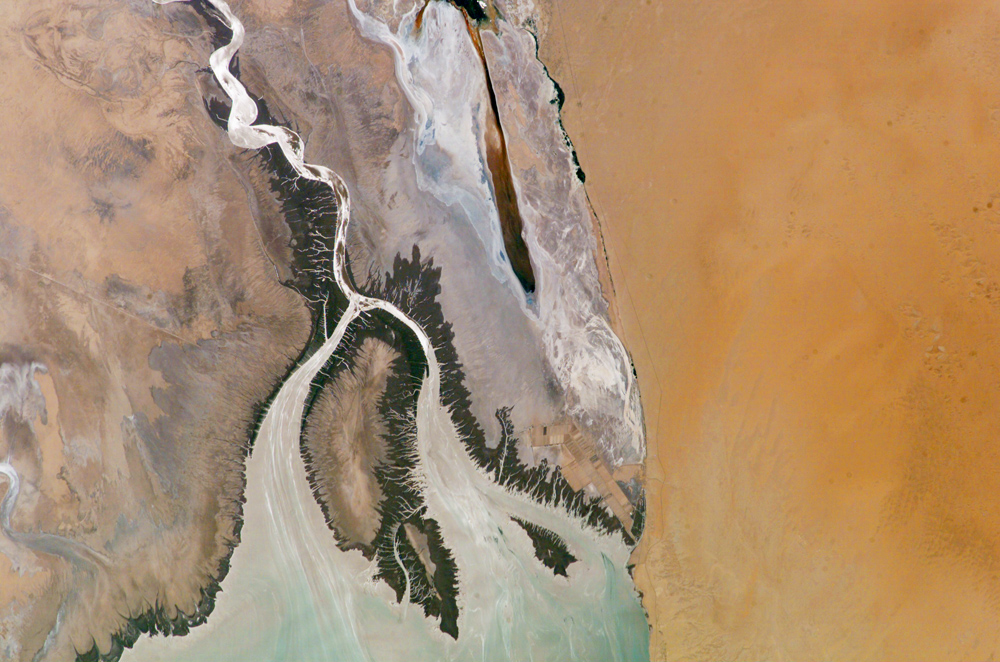
Colorado River delta in Mexico
For the first time in 16 years, the Colorado River has managed to flow into the Gulf of Cortez.  This is big news, because for the past 50 years, it has been rare for the Colorado to actually get to the sea.  Increased water needs from a rapidly growing population will do that, and since the Colorado is really the only river of note in that portion of the country, it was inevitable that it was going to get sucked dry.

Unfortunately, this was not a natural occurrence.  It was all part of a project to artificially flood the river in order to restore the Colorado's delta in Mexico.  Actually, the fact that water reached the ocean is good news, it means that the potential for restoration in the delta area is even greater than anticipated.  This project will continue to allow a smaller flow of water into the delta for the next three years, which will also help to restore plant and bird life in the area.

My Other Blogs
Loose on the Internet
Cool Golf News

My Twitter

Wednesday, May 21, 2014

Confirmed: A Certain Kind of Big Star Explodes Like All the Other Big Stars

Our sun is not a small star, but there are plenty of stars that are bigger than it.  However, stars do have an upper limit to the size they can grow.  Stars with more than 20 solar masses are very uncommon, but Wolf-Rayet stars are very rare, even in this very small subset of stars.  A Wolf-Rayet star is a massive star that is unusually hot, which causes intense solar winds.  This cause the star to eject material at an extremely high rate, losing the mass of the Earth to space every year, a billion times higher than what the sun does.  There are only a few hundred known Wolf-Rayet stars, and we were unsure of how they died.  It would make sense that they went supernova, like all the other stars that are a bit more massive than the sun, but because we know of so few and the unique way they die, we've never actually witnessed a Wolf-Rayet star go supernova.  Until now.

Astronomers were able to focus on supernova SN 2013cu mere hours after it was discovered, and this allowed the observation of ionized particles around the exploding star, a phenomenon that only lasts about a day.  This is important because it allowed astronomers to accurately identify what the material surrounding the star actually was, and in this case, this material almost certainly came from a Wolf-Rayet star.  This means that scientists can now say that Wolf-Rayet stars do go supernova like other stars of comparable size.  This seems like a no-brainer, but we weren't entirely sure.  Confirmation is important in science.

My Other Blogs
Loose on the Internet
Cool Golf News

My Twitter


Tuesday, May 20, 2014

Kepler Is Back

The Kepler Telescope has been our primary exoplanet hunting tool since its launch in 2009, but last May, it developed a problem.  The satellite has four stabilizing reaction wheels, and while it can operate with only three of them, it cannot operate with only two, and that is precisely what happened.  However, NASA has approved a new mission for Kepler that would not require three reaction wheels.  This new mission, called K2, involves using pressure from solar radiation to help stabilize the craft.  The new target area is much bigger than before and is located along the same plane as the Earth.

It's too bad that Kepler won't be able to complete its survey of the original search area, it's going to take many years for scientists to sift through the data, point their telescopes at potential planets, and actually confirm that what Kepler saw were actually planets.  But, so long as Kepler remains in its current state, we can now look at a completely new section of the sky, and find even more planets. 

My Other Blogs
Loose on the Internet
Cool Golf News

My Twitter


Sunday, May 18, 2014

Cosmos Episode 11 Thoughts

We're getting down towards the end of the series, and the discussion is starting to get a bit more serious.  Tonight, the show was about the persistence of life, and the pursuit of all life to attain immortality.  Life would simply not work if it was not able to weather the harshest of conditions or do whatever it takes to survive.

Life on Earth has taken many routes to ensure its own survival.  There are bacteria that can survive the vacuum of space and being frozen in ice for millions of years.  If these organisms can handle these conditions, would it not be unreasonable that life could have migrated here from somewhere else, or that Earth itself has colonized another world with our own life?  There are bacteria with extraordinary abilities that go unused on Earth, so why have them at all, if they evolved on Earth?  It's an interesting thought, although I am still in favor of life on Earth being native to Earth.  I'm just not sure if bacteria really could make the journey in between worlds like that.

I think there was a missed opportunity when Tyson discussed dandelions and the adaptation their seeds possess, floating on the wind for hundreds of miles to settle new and unknown areas.  The dandelion was a very important symbol in the original Cosmos for that reason, the Ship of the Imagination was a dandelion seed.  I guess since they already quoted the original show before, they didn't want too many references in one episode.  It would have been nice though.

When it comes to achieving immortality, humanity has an advantage.  We invented writing, we have a way to permanently preserve our thoughts, our feelings, our history for all time.  We can learn from past mistakes, we are endlessly adaptable, and of course, we are intelligent.  Humanity has so many things going for it, there is no good reason for our species not to endure indefinitely.  Sometimes now, it does feel like we are permanently sabotaging ourselves, and the worst part is that we know we're doing it.  Maybe this time will seem better when viewing it through the eyes of history, and many things have improved dramatically.  It just feels like we could do better.

My Other Blogs
Loose on the Internet
Cool Golf News

My Twitter

Saturday, May 17, 2014

Is the Great Red Spot Disappearing?

It's hard to imagine Jupiter without its iconic storm, which, next to Saturn's rings, is the most well-known feature in the solar system.  But, observations have shown that the Great Red Spot is shrinking.  Right now, it's only 10,000 miles across, and not even two Earths could fit in that distance, let alone the three we always here about.  This storm has been around for as long as we've been able to observe it, it's difficult to imagine the planet with that big swirling storm.  How will elementary school kids be able to draw Jupiter without a Great Red Spot?  Maybe this is only a temporary thing, maybe it will get better.  Then again, storms can't last forever, even on a gas giant.  Maybe the Great Red Spot is seeing its final days.

My Other Blogs
Loose on the Internet
Cool Golf News

My Twitter