
Well, that's it for Cosmos: A Spacetime Odyssey. This last episode was very contemplative, as it should have been. As is tradition in Cosmos, we started off in one of the most interesting and far-thinking places of the ancient world: the Library of Alexandria. Sure, the ancients were far from perfect, and the knowledge collected there was only for a select few. But for several hundred years, the Library was dedicated to the collection of all the knowledge in the ancient world, and the city of Alexandria became a metropolis of not just Egypt, but the entire world. People there were citizens of a broader universe then the relatively small Nile delta the city sits on. Athens and Rome may have been great cities, the centers of glorious civilizations, but there would not be another city like Alexandria for a very, very long time.
A good portion of the episode was spent on dark matter. The idea of dark matter was first brought up by crazy old Fritz Zwicky back in the 1930's, but with no good evidence to back up his claim, that idea was forgotten. At the time, the idea of dark matter was silly. 40 years later, scientists began looking at the rotation of galaxies, watching the stars orbit around, anticipating that stars in the outer portion of the galaxy would move much slower than stars in a closer orbit, just like the planets in the outer solar system move slower than the ones in the inner solar system. This went against everything we knew about gravity. There were two option, either Einstein and Newton were completely wrong, or there was something there that we couldn't see exerting a whole lot of gravity on these galaxies. That something is dark matter. It took a long time for Zwicky's idea to be proven correct, and it very easily could have been wrong. Scientists of the 1930's were perfectly capable, but their equipment was just not up to the task, and nobody bothered to look. As it turns out, all the visible matter in the universe, every last bit of it, is only about 5% of the total mass of the universe. A third of it is dark matter, and the rest is the even more mysterious dark energy, which is pushing the universe apart at an accelerating rate.
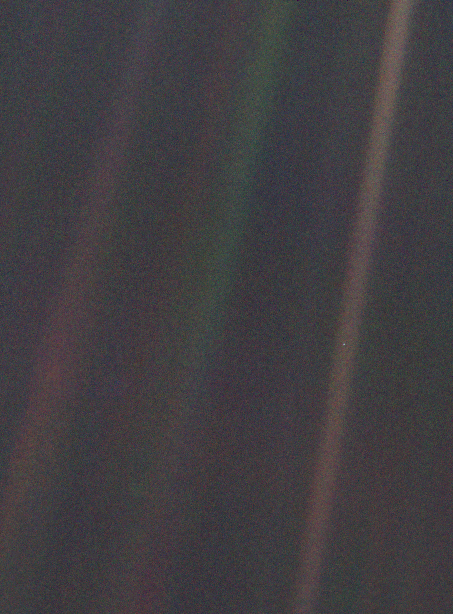
You could argue about what mankind's greatest achievement has been, but the Voyager space probes are definitely near the top of that list. For the first time, we built something that is going beyond the solar system, beyond any influence of Earth, into the great unknown. Maybe one day somebody will read the messages they bear, or maybe one day our own descendents will stumble across them after all knowledge of them has been lost to time. But they're out there, and of course, they are responsible for one of the greatest images ever taken: the Pale Blue Dot. We got quite a bit of Carl Sagan as we heard his thoughts on this absolutely incredible image, and that picture is every bit as evocative now as it was then. Our planet, as big as it seems to us, is reduced to a single, slightly blue pixel in a vast, empty space. Everything we know and have ever known is on that pixel. Frankly, I can't imagine someone going, "Well, I know enough right now." The thought of a infinite universe that I can never fully understand is more comforting to me. I would go so far as to say that I hope I never do learn everything there is to know about the universe, because what would I do with infinite knowledge? It would be boring.
The series closes with a meditation on science itself. We hear about the importance of a free society where ideas can be discussed without fear of censure or retribution. We learn about the importance of challenging authority, that nobody can tell you that something is true without first giving you actual proof. The importance of experimentation, and the thing that I found most important, that everyone, even the greatest scientists, can be wrong. Nobody is right about everything, because we are all only human. Science is a tool, but we can misuse it, and it is our duty to make sure science does not get misused. I think that was the most relevant point made in this series. The original Cosmos introduced science to the masses, before that, nobody had ever attempted such an ambitious show on science on national TV. This Cosmos recognizes that it doesn't need to do the same thing, instead, it needed to remind us about what science really is, how it's being misused, and what we can do to claim it again for all the people of Earth. We don't want science to be held by the elite, we want science to be for everyone. So while the two series might be different in a lot of ways, in that one way, they are the same, and that's what's important.
My Other Blogs
Loose on the Internet
Cool Golf News
My Twitter
 Why do this to a space probe that's done so much? After all, we didn't send the Voyager probes into any planets. In both Galileo and Cassini's cases, NASA wants to protect potential biospheres from any interference from Earth. Both Titan and Enceladus could host life, and we don't want to introduce any foreign objects into a pristine ecosystem until we're sure we won't do it any harm. Now, Cassini still has two and a half years before this happens, so there's still plenty of time left in its mission. But after Cassini goes, there won't be much human presence in the outer solar system. There are plans for probes to go to all of the moons that potentially host life out there, but for now, that's all they are, and it'll be a while before they get off the ground, if at all. So, enjoy Cassini while it's still there.


