Showing posts with label cosmos. Show all posts

Sunday, June 8, 2014

Cosmos Episode 13 Thoughts

Well, that's it for Cosmos: A Spacetime Odyssey.  This last episode was very contemplative, as it should have been.  As is tradition in Cosmos, we started off in one of the most interesting and far-thinking places of the ancient world: the Library of Alexandria.  Sure, the ancients were far from perfect, and the knowledge collected there was only for a select few.  But for several hundred years, the Library was dedicated to the collection of all the knowledge in the ancient world, and the city of Alexandria became a metropolis of not just Egypt, but the entire world.  People there were citizens of a broader universe then the relatively small Nile delta the city sits on.  Athens and Rome may have been great cities, the centers of glorious civilizations, but there would not be another city like Alexandria for a very, very long time.

A good portion of the episode was spent on dark matter.  The idea of dark matter was first brought up by crazy old Fritz Zwicky back in the 1930's, but with no good evidence to back up his claim, that idea was forgotten.  At the time, the idea of dark matter was silly.  40 years later, scientists began looking at the rotation of galaxies, watching the stars orbit around, anticipating that stars in the outer portion of the galaxy would move much slower than stars in a closer orbit, just like the planets in the outer solar system move slower than the ones in the inner solar system.  This went against everything we knew about gravity.  There were two option, either Einstein and Newton were completely wrong, or there was something there that we couldn't see exerting a whole lot of gravity on these galaxies.  That something is dark matter.  It took a long time for Zwicky's idea to be proven correct, and it very easily could have been wrong.  Scientists of the 1930's were perfectly capable, but their equipment was just not up to the task, and nobody bothered to look.  As it turns out, all the visible matter in the universe, every last bit of it, is only about 5% of the total mass of the universe.  A third of it is dark matter, and the rest is the even more mysterious dark energy, which is pushing the universe apart at an accelerating rate.
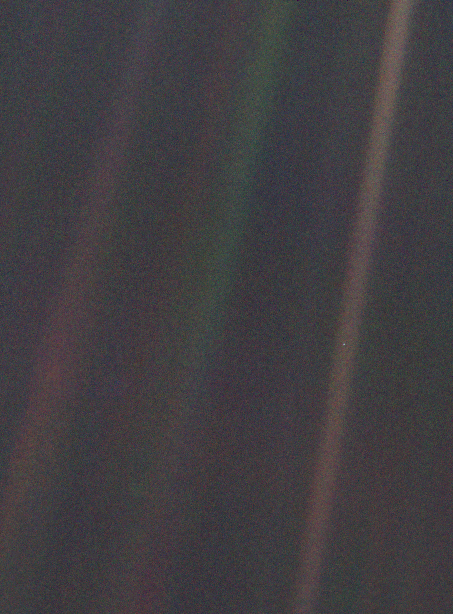
You could argue about what mankind's greatest achievement has been, but the Voyager space probes are definitely near the top of that list.  For the first time, we built something that is going beyond the solar system, beyond any influence of Earth, into the great unknown.  Maybe one day somebody will  read the messages they bear, or maybe one day our own descendents will stumble across them after all knowledge of them has been lost to time.  But they're out there, and of course, they are responsible for one of the greatest images ever taken: the Pale Blue Dot.  We got quite a bit of Carl Sagan as we heard his thoughts on this absolutely incredible image, and that picture is every bit as evocative now as it was then.  Our planet, as big as it seems to us, is reduced to a single, slightly blue pixel in a vast, empty space.  Everything we know and have ever known is on that pixel.  Frankly, I can't imagine someone going, "Well, I know enough right now."  The thought of a infinite universe that I can never fully understand is more comforting to me.  I would go so far as to say that I hope I never do learn everything there is to know about the universe, because what would I do with infinite knowledge?  It would be boring.

The series closes with a meditation on science itself.  We hear about the importance of a free society where ideas can be discussed without fear of censure or retribution.  We learn about the importance of challenging authority, that nobody can tell you that something is true without first giving you actual proof.  The importance of experimentation, and the thing that I found most important, that everyone, even the greatest scientists, can be wrong.  Nobody is right about everything, because we are all only human.  Science is a tool, but we can misuse it, and it is our duty to make sure science does not get misused.  I think that was the most relevant point made in this series.  The original Cosmos introduced science to the masses, before that, nobody had ever attempted such an ambitious show on science on national TV.  This Cosmos recognizes that it doesn't need to do the same thing, instead, it needed to remind us about what science really is, how it's being misused, and what we can do to claim it again for all the people of Earth.  We don't want science to be held by the elite, we want science to be for everyone.  So while the two series might be different in a lot of ways, in that one way, they are the same, and that's what's important.

My Other Blogs
Loose on the Internet
Cool Golf News

My Twitter

Sunday, June 1, 2014

Cosmos Episode 12 Thoughts

There was no episode last week, but there was today.  This was the second-to-last episode if the series, and the tone has definitely changed.  This Cosmos was always going to be different from the first one, and it definitely showed tonight.  The original focused more on revealing the wonders of the universe to a world that had never seen such things, this series exists more of a reminder and a gentle admonition of our rather lackluster stewardship of the planet.  Carl Sagan told us about our place in the universe and what we need to do to better the planet, Neil deGrasse Tyson is pushing us to follow through with our responsibilities.

Tonight was all about carbon dioxide.  It's a simple molecule, one carbon atom, two oxygen atoms, but it is responsible for so much.  Plants couldn't function without it, and without plants, there would be no animals, no people.  Without carbon dioxide in the atmosphere, the planet would be frozen solid.  Life depends on carbon dioxide's property as a greenhouse gas, but there has to be a balance.  There is a planet in our solar system which shows us what happens when there is too much carbon dioxide, and it's right next door.  Both series have made allusions to Venus when talking about the greenhouse effect, and while Earth will never be as bad as Venus, it will take less than we think to make Earth a very harsh place.

It's not like this is a recent thing, the issue about global warming.  We've known about it for a long time, and as we learned tonight, there were multiple junctures throughout history where we could have gone down a path of clean, renewable energy.  Unfortunately, the great tides of society were never on the side of solar power, instead always moving towards cheap fossil fuels.  Now is the time for a switch to be made, and the transition is happening, but it is slow and painful, we are dragging it out with fossil fuels until the bitter end.  Big energy companies will give us clean energy eventually, but only after getting every last dollar out of fossil fuels, and for a nation that loves to criticize big business, we sure seem happy to keep doing what we're doing.  Maybe Tyson will have something to say about that in the finale, maybe not, actually, I hope not.  I don't want the series to end with an indictment of what we've done, but rather look out and to the future, to a brighter time for mankind.

My Other Blogs
Loose on the Internet
Cool Golf News

My Twitter
Sunday, May 18, 2014

Cosmos Episode 11 Thoughts

We're getting down towards the end of the series, and the discussion is starting to get a bit more serious.  Tonight, the show was about the persistence of life, and the pursuit of all life to attain immortality.  Life would simply not work if it was not able to weather the harshest of conditions or do whatever it takes to survive.

Life on Earth has taken many routes to ensure its own survival.  There are bacteria that can survive the vacuum of space and being frozen in ice for millions of years.  If these organisms can handle these conditions, would it not be unreasonable that life could have migrated here from somewhere else, or that Earth itself has colonized another world with our own life?  There are bacteria with extraordinary abilities that go unused on Earth, so why have them at all, if they evolved on Earth?  It's an interesting thought, although I am still in favor of life on Earth being native to Earth.  I'm just not sure if bacteria really could make the journey in between worlds like that.

I think there was a missed opportunity when Tyson discussed dandelions and the adaptation their seeds possess, floating on the wind for hundreds of miles to settle new and unknown areas.  The dandelion was a very important symbol in the original Cosmos for that reason, the Ship of the Imagination was a dandelion seed.  I guess since they already quoted the original show before, they didn't want too many references in one episode.  It would have been nice though.

When it comes to achieving immortality, humanity has an advantage.  We invented writing, we have a way to permanently preserve our thoughts, our feelings, our history for all time.  We can learn from past mistakes, we are endlessly adaptable, and of course, we are intelligent.  Humanity has so many things going for it, there is no good reason for our species not to endure indefinitely.  Sometimes now, it does feel like we are permanently sabotaging ourselves, and the worst part is that we know we're doing it.  Maybe this time will seem better when viewing it through the eyes of history, and many things have improved dramatically.  It just feels like we could do better.

My Other Blogs
Loose on the Internet
Cool Golf News

My Twitter

Wednesday, May 14, 2014

Cosmos Episode 10 Thoughts

I didn't get a chance to watch this week's episode when it was new, but I have finally gotten around to it, and it was a good one.  This episode was all about one person, and this series has been at its best whenever it's done that.  Michael Faraday isn't exactly an obscure figure, but considering his contributions to science, he really doesn't get the attention he deserves.

Faraday was a major figure in 19th century science, but unlike most of the other scientists in England during the time, he did not come from privileged means.  Faraday never even made it past elementary school.  He started working when he was 13, and in one of life's moments of luck, he started working in a bookstore.  Here, he read all about electricity, a curiosity at this time, and became absolutely fascinated with it.  He began attending lectures by Humphrey Davy, a scientific superstar of the day, and took diligent notes on these lectures.  He sent these notes to Davy, who remembered them when he temporarily lost his eyesight in a failed experiment.  He hired Faraday as a secretary for his experiments, but more importantly, he allowed Faraday to tinker with the equipment himself.  Davy probably didn't expect anything from Faraday, but this does serve a valuable lesson.  It doesn't matter if you believe if someone can change the world, but if you give them the means to do so, they just might surprise you.

Faraday's efforts are all the more impressive when you consider the fact that he dealt with memory loss and depression for most of his life.  When presented with such adversity, there are a select few who take it as a challenge, and bring their minds to new heights.  Faraday was one of these people, and even as his mind betrayed him, he accomplished more and more.  Despite all of this, Faraday still had limitations, and he knew it.  He was no mathematician, he had barely any formal education.  But when James Clerk Maxwell delivered a book to Faraday's desk, providing him with all the equations he needed to prove his theories, he embraced Maxwell and his work, providing Maxwell with a huge boost.  Maxwell would become an enormously influential scientist, and another man who perhaps does not get as much credit in the history books as he should.  Newton and Einstein are justly famous for their work on gravity, but compared to Faraday and Maxwell's work with electromagnetism, there is no practical comparison.  Electromagnetism runs the modern world, it unites us all.  Sure, we can see gravity acting every day, but outside of a classroom, how often do we apply Einstein's laws, or even Newton's.  But, as Tyson made clear, without Faraday, the very devices you're reading this on and that we all depend on would not be possible.

My Other Blogs
Loose on the Internet
Cool Golf News

My Twitter

Sunday, May 4, 2014

Cosmos Episode 9 Thoughts

We stayed close to home tonight on Cosmos, traveling in time rather than in space.  But as we heard, while it may be the same planet, there have been many Earths, each very different from our own.  We started off with a lesson about plate tectonics.  Looking back, it seems so obvious that the continents were once connected, the shape of the Atlantic Ocean and the coastline of the Americas against Europe and Africa get noticed by any observant elementary student who is presented with a map.  The first cartographer to make a reasonably accurate map of the world back in the late 16th century noticed the same thing, but his observation remained only speculation, a footnote until the 20th century.  The story of Alfred Wegener is well known, but the story of Marie Tharp and the discovery of the Mid-Atlantic Ridge is not, and it was a neat little bit of information.

Next we moved into the distant past, more than 300 million years ago.  This was the Carboniferous period, a time when trees first appeared and giant insects roamed the Earth.  This age is very important in our current time, because way back when, there were no organisms that could digest the lignin in the trees which is what made them grow, so instead of the tree being digested and its contents eventually returned to the environment, it was buried and eventually turned into coal.  We also got a similar story about the Guadalupe Mountains in Texas, which was once a shallow tropical sea, full of life.  As things died, they became buried under silt, and eventually turned into oil and gas.  This is the era where we got our fossil fuels.

This episode featured a return to the Hall of Extinction, which we last visited in episode two.  We learned about the Permian extinction, and how the Earth itself seemed to conspire against life.  I think that brought home a valuable lesson. The Earth can support and nurture life, and then for no reason turn against it.  Nature is a powerful force.  We learned all about how plate tectonics has shaped our world, and I thought the story of the Mediterranean Sea was particularly interesting.  I didn't know that it was so young, that it had been so inhospitable before it flooded, and that it was formed so quickly, over a span of just a year or two.  Geologically speaking, that is remarkably quick.

We finished things off tonight with a warning.  Our dependence on fossil fuel is pouring carbon dioxide into the atmosphere at a rate not seen in a very, very long time.  There have been five mass extinctions in Earth's history, could we cause the sixth?  If we're not careful, the Earth could be a much harsher place in the near future.  I hope I'm not being optimistic here, but things are changing for the better.  In ten years, I think we will be much further along in the road to clean energy then we think we will be.  The tides are coming in, the slow march of progress in society is turning towards renewable energy.  There might be plenty of fossil fuel left, but the costs of extracting it will become prohibitive long before they run out.  Through government regulation, start-up energy companies, public opinion, things are slowly but definitely changing.

My Other Blogs
Loose on the Internet
Cool Golf News

My Twitter

Sunday, April 27, 2014

Cosmos Episode 8 Thoughts

For tonight's show, there was not just one star, but many.  Billions and billions of them.  Those little lights in the sky have confounded and inspired mankind for as long as we have had thoughts in our head, but it took us a very long time to truly understand them.  I have to confess, I missed the first five minutes because I was out getting groceries (it was the earliest I could get them), but from what I gathered, the first segment was about ancients and how they organized the stars into constellations, making sense of a chaotic system.  I thought the Aborgine system was particularly interesting, instead of using the stars, they used the great dark patches of the Milky in the same fashion.  A different solution to the same problem, but it worked for them.

Next we moved to the 1920's, and the efforts of a group of women who catalogued the stars, creating a classification system still used today.  So far, this show has done a very good job of weaving the story of unknown scientists with the story of the universe around us, but I didn't think that was the case today.  We got their story in one block, which took 15 minutes and was over when the show hit the halfway point.  I think it was a story worth telling, but today, I don't think it was told in the best fashion.

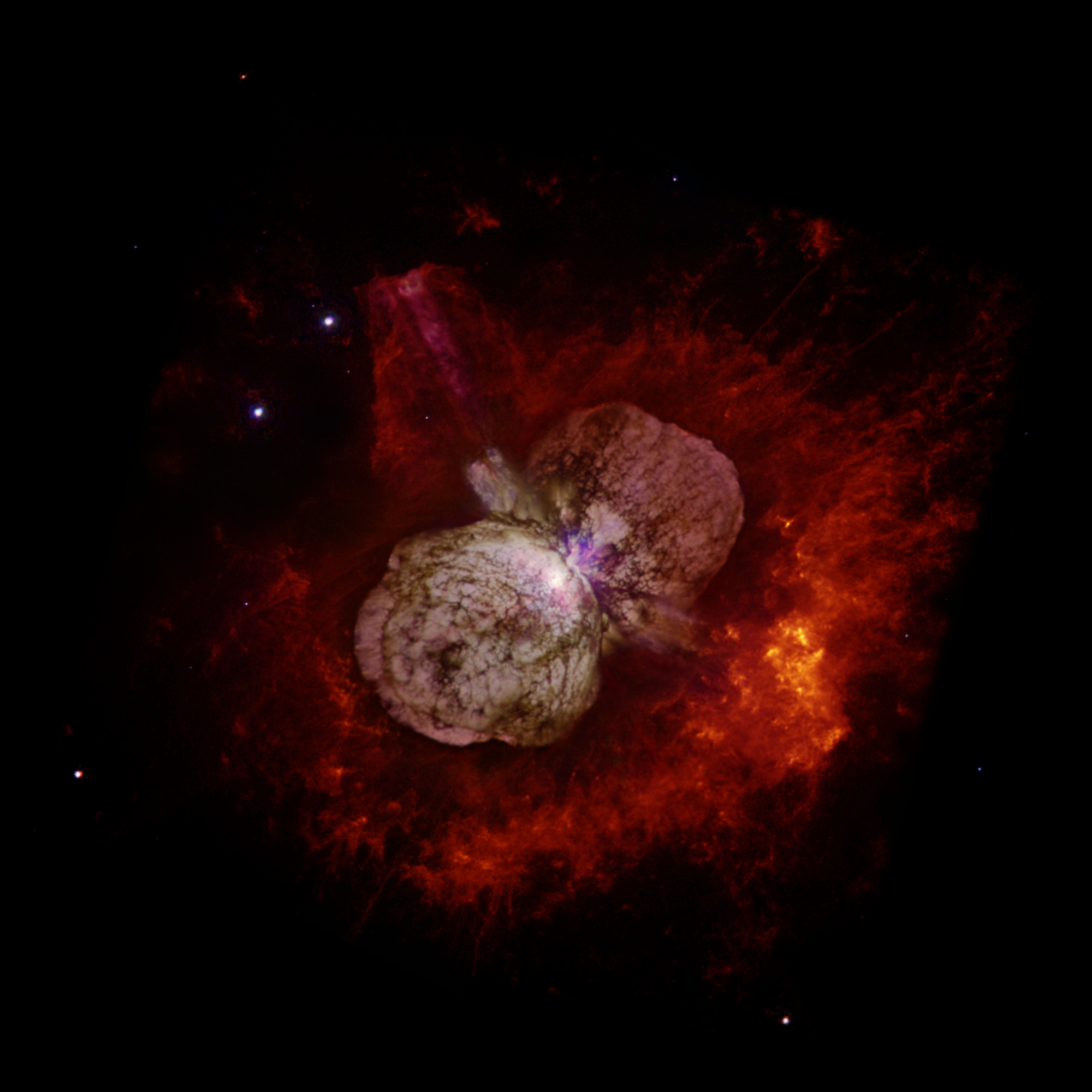
Eta Carinae within the Homunculus Nebula
The second half of the show was all about the stars, namely, what their lives are like, and how stars die.  Stars like our sun die fairly peacefully and become white dwarfs, while bigger stars suffer a more violent fate.  The supernova is an incredible event, and if one occurs close to Earth, it can dominate the night sky.  But, a star can die in an even more spectacular fashion.  Personally, I knew immediately that Tyson was talking about Eta Carinae, so the big lead-up didn't do much for me, but I think that it was a very interesting topic nonetheless.  It's a fascinating star, and when it goes, it will be spectacular.

Speaking of spectacular, the show closed with an incredible image, and what would probably be one of the greatest sights in the whole universe.  On a far-off world orbiting a sun in a globular cluster, a ball of a million stars hovering around the Milky Way, there would be sunrises and sunsets just like any other planet, but there would also be galaxy-rise.  Just imagine watching the enormity of our entire galaxy rising over the dark horizon, with its 200 billion stars shining in the darkness.  It's an image that the first Cosmos also gave us, and it is still just as incredible image now as it was then.

From Cosmos. Still as majestic as ever

My Other Blogs
Loose on the Internet
Cool Golf News

My Twitter

Sunday, April 20, 2014

Cosmos Episode 7 Thoughts

This iteration of Cosmos has done a lot of things very well, and one of the most notable of those things is shining the spotlight on scientists who most people haven't heard of.  Tonight's episode was the most prominent example of this, as it was entirely devoted to the story of Clair Patterson and his efforts to discover the true age of the Earth.

To be honest, if I were to describe this episode to someone, it really wouldn't sound very interesting.  After all, the main star of the show, besides Patterson, is lead.  Without the decay of uranium into lead, it would have been impossible to discover the age of the Earth.  Really, this episode was more about the importance of pursuing the truth, especially in the presence of special interests.

When working to find the age of the Earth, Patterson discovered that most of the samples he was working with had a much higher concentration of lead than they should.  After years of travelling the world, collecting samples from basically everywhere, he discovered that the high concentration of lead was a recent phenomenon.  More specifically, he figured out that leaded gasoline was poisoning the population and was incredibly dangerous.  It took 20 years, but leaded gasoline was eventually banned, despite the immense power and influence of the petroleum industry.  The lesson here is that eventually, no matter how powerful the opponent, science and truth will win out in the end.  And that is good news.

My Other Blogs
Loose on the Internet
Cool Golf News

My Twitter

Sunday, April 6, 2014

Cosmos Episode 5 Thoughts

Light really is incredible.  That's why we had an entire episode tonight devoted to light, and more specifically, what light is.  I really like the focus on scientists who, until now, were completely unknown outside the mainstream.  Until this point, I had known of all the scientists that have been featured, but I have to confess, I had no idea who Joseph von Fraunhofer was.  Optics has never really been my thing, so I guess that's not too surprising.

Tonight, we started off in ancient China, and how a Chinese astronomer (whose name eludes me) was the first to really experiment with light, along with a stern warning about how science requires freedom of expression to thrive.  It's true, you can't exactly do much science if you're not allowed to question the status quo.  Next we moved to medieval Iraq, and the scientist Ibn al-Haytham, the father of modern optics.  His work was revolutionary, but equally important in this segment was that for several hundred years, the Middle East was the center of science and free expression.  Funny enough, I'd recently done a bit of research into the Abbasid Caliphate, the empire that al-Haytham worked in, and it was simply remarkable.  We owe so much to them, and they are for the most part left out of the history books.  I guess you can blame the Mongols for that one.

After a brief detour at Isaac Newton's house, when he nearly discovered spectroscopy, and to William Herschel discovering that there is more light then what we can see; the show moves to early 19th century Bavaria, and to the most important figure of the episode, Joseph von Fraunhofer.  His life is just another example of how sometimes, things just come down to luck.  If that house hadn't collapsed, how much longer would it have taken for someone to discover the revolutionary science of spectroscopy?  At the same time, how much more would we know now if Isaac Newton had gotten to it first?  He was obsessed with optics, he could have easily done it.

Of course, the most important player in all of this is light itself, which is absolutely remarkable in every way.  We haven't even learned everything there is to know about light yet, it get even stranger from here.  I enjoyed the ending segment, seeing the city illuminated in every time of light, not just in visible.  The X-ray city was particularly cool-looking.  It really is incredible how much we don't see, but at the same time, we can see so much.

My Other Blogs
Loose on the Internet
Cool Golf News

My Twitter

Monday, March 31, 2014

Cosmos Episode 4 Thoughts

This Cosmos reboot just keeps getting better and better.  This last episode was all about gravity, light, and William Herschel.  Herschel, like Halley from last week, made incredible contributions to science, only to have most of them ignored.  Yes, discovering Uranus was very important, but his work with binary star systems was inspired.  Herschel was not the first to observe binaries, and as last night's episode revealed, his contemporary John Michell theorized their mechanics first, but Herschel's work would prove the most fruitful.  I really enjoyed the animated segments with Herschel and his son, it was interesting.

Last night's episode also recreated a segment from Carl Sagan's Cosmos, and one of Einstein's classic thought experiments on the nature of light.  Time dilation and the nature of light while moving at relativistic speeds is always fascinating to hear about, and while it may not be possible to really understand it, I think Tyson made it easy for people to at least wrap their mind around the idea.

The best part of the episode was the black holes.  From the animation of Herschel talking about dark stars to the black hole dive with callbacks to 2001: A Space Odyssey, it was an intense and enlightening segment.  Sure, it was all theory crafting because we have no idea what happens within a black hole, but this is the ship of the imagination.  And if we do ever figure black holes out, the truth will always be stranger than what we can possibly imagine.  From the black hole, we went straight to the most poignant part, where Tyson talked about John Herschel, and how photography is a sort of time travel.  A great episode, from start to finish.

My Other Blogs
Loose on the Internet
Cool Golf News

My Twitter

Sunday, March 23, 2014

Cosmos Episode 3 Thoughts

Been really busy the past few days, which is why there's two posts in a row about Cosmos.  Trust me, there will be other subjects eventually.  But, onto tonight's episode, which was all about comets and Edmund Halley.  On the surface, this episode didn't seem to say nearly as much as the previous two episodes.  It seemed like a history lesson about comets, which, while interesting, hardly seem worthy of an hour's worth of time, especially considering that the show only has 13 episodes to explore literally all of the universe.

There are some very important things this episode went over.  First off, it gave a voice to a man whose contributions to science have been cut down dramatically.  Edmund Halley was far more than the namesake of the comet.  It also showed that time and time again, history is a fascinating thing.  Who knows what our world would look like if Halley hadn't personally published Newton's book?  So many things in history have come down to one person in the right place at the right time.  Most importantly, it shows that mankind has the capacity for knowledge to triumph over fear.  For most of human history, comets were looked at as bad omens, but the extraordinary persistence and intelligence of a few people conquered that fear.  It has been this way throughout history, and it will continue to be this way.  Mankind will always seek to conquer its fears, and it is important to remember that.

I feel like there's a lot of doom and gloom about mankind's future, I even had a professor flat out tell our class that she thought mankind was doomed.  I don't believe this, I refuse to.  Humanity has a bright future ahead of us, and it's important to always believe that.  Once we stop, that's when mankind is truly doomed.

My Other Blogs
Loose on the Internet
Cool Golf News

My Twitter

Thursday, March 20, 2014

Cosmos Episode 1 and 2 Thoughts

The revival of Cosmos is big news for everyone who cares about science.  I loved the old series, but after so many years, it needed updating.  While much of what Carl Sagan said remains as inspiring as it did when he first said them, the fact is science has moved on.  The new graphics certainly help too, showing the universe in its full glory.  So, how has Neil deGrasse Tyson done so far?

The first episode is about our place in the universe.  While I have to say I preferred the old ship of the imagination to the new one, everything else was fantastic.  I wasn't sure at first how I felt about the animation of Bruno's life, but I decided that it works.  You can take more liberty with animation, you can make the world more vibrant, more imaginative.  The story Tyson told at the end about how he met Carl Sagan was remarkable, and it really gave a good grounding to a cosmic adventure that literally went to the edge of the universe.

The second episode was about life, and the incredible journey it has taken to get to where it is today.  There's no denying the fact that evolution is still a hotly contested concept, and the fact that there are still so many people who flat-out deny it was an unavoidable subject.  However, it was kept to a minimum, and it was handled without explicitly insulting those who don't believe in evolution.  Tyson brings up a couple of great points, mentioning that gravity, like evolution, is a theory, but that doesn't stop them from being true.  He also mentions that the great thing about science is that belief doesn't stop it from being the truth.  I also really liked the ending, and the return of the 40 second journey from the first DNA to human life.  That was one of the most potent parts of the original, and since nothing's changed, it made perfect sense to bring it back.  The combination of the elegance of the format along with the complexity of life makes for a potent image.

Things are looking good so far.  I can't wait for the next episode.

My Other Blogs
Loose on the Internet
Cool Golf News

My Twitter