Showing posts with label physics. Show all posts

Monday, June 30, 2014

Questioning Everything About Quantum Mechanics

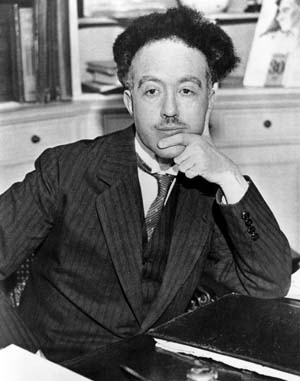
Quantum mechanics has always been kind of a weird concept.  The whole idea of reality coming down to a series of probabilities is not easy to wrap your head around.  However, in the early 20th century, there were two interpretations of quantum mechanics.  The first is what we know today, the probabilistic version most advocated by Niels Bohr, and the pilot-wave theory, proposed by Louis de but there has been a challenge to the standard model of quantum mechanics from the field of fluid dynamics.
Broglie.  People didn't really like Bohr's version, most notably Albert Einstein, which should have boded well for de Broglie's theory, since it was deterministic at its heart.  But for whatever reason, Bohr's theory caught on, and it didn't take long for pilot-wave theory to become a complete joke in the scientific community.  That's how it's remained for the past 80 years,

What is pilot-wave theory anyway?  It comes, obviously, from pilot waves, which form when ripples
in a liquid interact with each other.  De Broglie's theory said that particles work in the same way, as the effects of particles on each other cause the quantum effects we see in the double-slit experiment, for example.  According to probabilistic quantum theory, that effect is caused by the inherent unpredictability of the particles, but according to pilot-wave theory, the particles do have a definite path, we just can't determine it exactly.  The important part is that, theoretically anyway, if we knew the exact position of all particles in the universe at one time, we could determine their future paths with certainty.

So, where does fluid dynamics enter into this?  An experiment was recently done where a drop of silicon oil was placed in a liquid and the entire thing was vibrated.  At a certain frequency the drop bounced along the surface in the same way de Broglie proposed in the pilot-wave theory.  This was a curiosity that could not be ignored.  So, the scientists recreated the double-slit experiment in fluids, and found that the pilot waves would travel through both slits, while other droplets would pick one or the other.  They duplicated the results of the double-slit experiment within classical physics, which is, according to the standard model of quantum mechanics, impossible.  In many other tests, the liquids also duplicated the behavior of pilot-wave quantum theory, and the results are undeniably very interesting.

There's always a but with science, and of course, there's one here.  Right now, all we have is some interesting results from one experiment, and at this point, pilot-wave theory cannot explain many things that regular quantum mechanics can.  Given adequate research time, answers may be found, but there is the second and even bigger problem.  Physicists, on the whole, don't seem willing to give this theory a fair chance.  Pilot-wave theory never had a good reputation, and in our current system, reputation matters.  Who's going to give a grant to research a theory that nobody takes seriously?  Universities don't like to see their money disappear without positive results, and there's a very good chance pilot-wave theory comes up empty.  It's the nature of the field.  Results are nice, but you learn just as much from every negative answer, and who knows, maybe one of those crazy ideas you're sure can't be right actually wasn't so crazy after all.  You never know unless you test it.

My Other Blogs
Loose on the Internet
Cool Golf News

My Twitter


Wednesday, June 25, 2014

Learning New Things About Science

It's always nice to learn something new about science.  For instance, up to this point, I thought that there were only four states of matter: solids, liquids, gases, and plasma.  However, I just learned today there's a fifth state of matter, known as a Bose-Einstein condensate.  This isn't new, but it's so fundamental that I'm surprised this wasn't a bigger story.  I guess that since a lot of the time you only hear about three states of matter, the fact there's five is not a big deal.  We at least encounter plasma occasionally in our daily lives, but we'll probably never encounter a Bose-Einstein condensate.  Still, I think it's important to know as much as you can, even if all that knowledge isn't imminently practical.  So, read all about Bose-Einstein condensates, and expand your mind.

My Other Blogs
Loose on the Internet
Cool Golf News

My Twitter
Friday, June 20, 2014

Very Tiny Gravitational Constant Measured

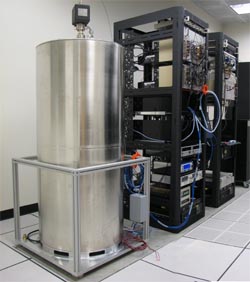
A rubidium fountain, though this is a clock, not an experiment.
Wait a minute, says everyone who's taken a physics class.  Don't we already know what the
gravitational constant is?  Isn't it part of Newton's equations? Yes, the gravitational constant has been measured many times, although not actually by Newton himself.  It was first calculated in 1798, and has been adjusted quite a bit over the years to considerable accuracy.  Or so we thought.  As it turns out, all those values for the gravitational constant in the equation
Fg = G * m1m2 / r2 were wrong.  The problem is that the gravitational force is so tiny that virtually anything could cause errors.  So the value of the gravitational constant is not nearly as well known as other constants such as the speed of light.


In an experiment involving a rubidium atomic fountain and several hundred kilograms of tungsten, scientists have found an error-free value for the gravitational constant.  The value they got is 6.67191 × 10⁻¹¹ m3 kg-1 s-2, while the previously accepted value was 6.67384 × 10⁻¹¹ m3 kg-1 s-2.  That doesn't sound like very much, I know I only used 6.67 in my physics classes, and I'm sure that's all anybody would use just using that equation casually.  But for physicists, that is a big difference.  This new value isn't as precise as old values, but it is more accurate, and it raises hopes that a both precise and accurate value for the gravitational constant will soon be agreed upon.

My Other Blogs
Loose on the Internet
Cool Golf News

My Twitter

Friday, June 6, 2014

The Search Continues for the Source of All Matter

The Enriched Xenon Observatory, where the experiment took place.
It's one of the great mysteries of the very early universe.  Where did all the matter in the universe come from?  The current theories maintain that equal amounts of matter and antimatter should have been created just after the Big Bang, but obviously, this can't be the case.  There is a lot of matter floating around, but very little naturally occurring antimatter.  The answer to this conundrum could lie in Majorana particles, or particles that act as their own antimatter.  Such particles have been confirmed, but scientists wondered if neutrinos were also Majorana particles.  After a lengthy experiment, we've come up empty.

The lack of results doesn't necessarily prove that neutrinos don't act as their own antimatter particle, but it does make it unlikely.  The article also states that Majorana particles aren't the only way to reconcile the matter-antimatter disparity, of course, that research isn't going any better.  So, the mystery of matter continues on.

My Other Blogs
Loose on the Internet
Cool Golf News

My Twitter

Saturday, April 26, 2014

Quantum Mechanics and Why Your Food Cools Off

It seems like a simple question.  Why does a plate full of hot food cool off in a comparatively cool room.  It's a question addressed in the first law of thermodynamics, and it makes a lot of sense, intuitively speaking.  Of course heat is going to flow from an area of high temperature into an area of lower temperature until they reach equilibrium.  These laws of thermodynamics govern the fate of our entire universe, the inevitable flow of energy from an organized state into an unorganized state is known as entropy, and our universe is  bound to it.  Based on our observations of the universe, this seems to make sense, as the universe slowly moves from the ultra-condensed, ultra-ordered Big Bang state to the ultimate expression of entropy, the inevitable heat death of the universe, where only stray bits of energy remain. 

There is a big problem with entropy, however.  Physics is supposed to work both forwards and backwards.  The rules should be the same even if time is flowing backwards.  This is where thermodynamics runs into a problem.  Let's say you boil a pot of water and then turn the stove off.  Without a source of heat, the water will eventually cool off to the same temperature as the surrounding air.  Now, run that same scenario backwards.  For absolutely no reason, the water in the pot will begin to heat up, and there will be no reason why this will be occurring.  Sure, eventually the stove will turn on, but remember, time is flowing backwards in this scenario, and the cause cannot precede the effect, not according to physics, no matter which way time is flowing.  This, in a nutshell, is the problem of the arrow of time, a phrase coined by Arthur Eddington in the 1920's, and it has confounded scientists for a long time.

Scientists may have a solution to this fundamental problem with thermodynamics in quantum entanglement.  As with all quantum related things, entanglement defies common sense.  Basically, when two particles come into contact with each other, they interact with each other in an irreversible way, becoming entangled with each other.  Now, you could separate these particles, you could take them to opposite sides of the universe, but they would always remain related to each other.  If you've heard of Einstein's quote, "spooky action at a distance," he was referring to quantum entanglement.

What does quantum entanglement have to do with our hot pot of water?  According to this new theory, the information in the pot becomes entangled with the information in the surrounding air, leaking out and spreading around the environment.  The importance of this theory is that the information in the pot never actually disappears, it is just spread out into the universe.  This means that the entropy of the universe does not actually increase over time, but remains constant.  Quantum entanglement also means that it is possible for the pot to spontaneously heat itself again, although the likelihood of this is so small you would have to wait longer than the lifespan of the universe to witness it happening.  This is why the process was seen as being only one-way before, because there is no way to observe the opposite.

Of course, there are still problems with this theory, and it remains to be seen how practical it is in real-life applications.  But this theory does more than address why a pot of hot water cools off.  Another troubling issue concerning the arrow of time is how we perceive time, namely why we can remember the past but not the future.  With this new theory, there is a potential answer.  When we view something, the information becomes entangled with your brain, and only afterwards can you recall that information.  Basically, you are becoming entangle with your environment all the time.  It's an interesting idea, and we'll have to see where it can take us.

My Other Blogs
Loose on the Internet
Cool Golf News

My Twitter